Fraud Blocker

CARRARA TREATMENT / ADDICTION EXPERTS

Dr. Wendy Walsh: The Science of Love & Modern Relationships

EPISODE 69|47 min
Home/Addiction Experts/Attachment, Love, and Addiction: Dr. Wendy Walsh, PhD on the Science of Relation...

Episode Takeaways

  • Love is a science composed of biological, psychological, and social components — and relationship skills can be systematically learned and improved.
  • Anxious attachment — a deep fear of abandonment — is a primary driver of substance use as a neurobiological coping strategy for intolerable relational distress.
  • Research shows that sexual frequency beyond twice per week does not improve relationship satisfaction; high frequency sometimes signals anxiety rather than genuine connection.
  • Codependency and sex addiction are not formal DSM diagnoses; the correct clinical lens is whether a behavior impairs functional relationships, employment, or self-care.
  • Three evidence-based daily practices — expressing gratitude, identifying whose problem is whose, and developing conflict resolution skills — are associated with long-term relationship satisfaction.

About This Episode

Attachment theory is the scientific study of how early emotional bonds shape a person’s relational patterns, emotional regulation, and capacity for intimacy throughout adulthood. Disruptions to secure attachment in childhood — through inconsistent caregiving, abandonment, or relational trauma — produce anxiety or avoidance patterns that persist into adult relationships and, research consistently shows, substantially elevate the risk of substance use disorders later in life.

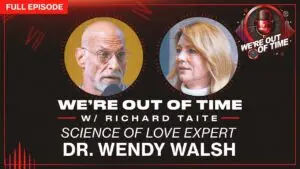
In this episode of We’re Out of Time, host Richard Taite sits down with Dr. Wendy Walsh, PhD, a psychology professor at California State University Channel Islands, author of The 30-Day Love Detox, and one of the most recognized public voices on the science of human relationships. Dr. Walsh has spent decades making complex research on love, attachment, and human behavior accessible to broad audiences, including through more than a decade hosting The Dr. Wendy Walsh Show on KFI AM640 iHeartRadio.

The conversation spans the three-part science of love — biological, psychological, and social — the research linking attachment styles to addictive behavior, the clinical distinction between codependency and genuine diagnostic impairment, and evidence-based practices drawn from long-term couples research. Dr. Walsh explains why love is often about familiarity rather than happiness, and why understanding that distinction is foundational to building healthier relationships in recovery.

For individuals and families navigating the intersection of substance use and relational difficulty, this episode provides an accessible, research-grounded framework for understanding why attachment wounds and addiction so frequently appear together — and what the path toward healthier relationships and lasting recovery looks like.

Key Insights

What Is the Science of Love?

▶ 01:28

Dr. Wendy Walsh argues that love is not a mystery but a measurable science composed of three distinct components: biology, psychology, and social conditioning. Biologically, humans are wired to attract mates based on genetic compatibility — research demonstrates that humans unconsciously detect immune system differences through scent, predisposing them toward partners with dissimilar genetic profiles. Psychologically, individuals are attracted to familiarity rather than happiness, drawn to partners who replicate relational patterns established in childhood with early caregivers. Socially, culture shapes what is perceived as desirable and which relational scripts feel natural. Walsh’s central thesis is that relationships are not about luck but skill — and relationship skills can be systematically learned and improved over time. For individuals in addiction recovery, this reframe carries direct clinical relevance: the relational difficulties that often accompany substance use disorders are not permanent character defects but learnable skills that respond directly to education, structured therapy, and consistent practice.

“Relationships aren't about luck, they're about skill. And when you have good relationship skills, you are not only attracted to more people, you're attractive to more people.”

How Do Attachment Patterns Connect to Addiction?

▶ 27:55

Dr. Walsh explains that anxious attachment — a style characterized by a deep, often unconscious fear of abandonment — is one of the most significant psychological underpinnings of addictive behavior. Individuals with anxious attachment cannot tolerate the discomfort of relational instability or separation, and they turn to substances as a coping strategy for those intolerable feelings. Walsh describes this as using substances as medicine for uncomfortable emotions — a framing that reframes addiction not as a moral failure but as a neurobiological response to an unmet attachment need. She notes that no single person expresses one attachment style across all relationships; the style may shift depending on whether the relationship is romantic, familial, or collegial. For clinicians treating co-occurring addiction and relational difficulties, Walsh’s framework reinforces the growing evidence base linking early attachment disruption to later substance use, and supports treatment models that address both the underlying relational wound and the substance use behavior in an integrated, sequenced approach.

“That's where the big overlap is. They are trying to use medicine as a coping strategy for the uncomfortable feelings.”

Does Sex Frequency Indicate a Healthy Relationship?

▶ 11:35

Research on relationship satisfaction shows that more sex does not necessarily indicate a healthier relationship — a finding Dr. Walsh highlights as counterintuitive in a highly sexualized culture. Studies comparing couples at different levels of sexual frequency find that increasing from once per week to twice per week measurably improves relationship satisfaction; beyond twice weekly, additional frequency produces no further measurable benefit. Walsh introduces a clinically important complication: some couples report high sexual frequency not because of genuine connection but because of anxiety — fear of abandonment, fear of infidelity, or attempts to manufacture intimacy that does not exist in other relationship domains. These couples, she notes, often report low overall relationship satisfaction despite frequent sexual activity. For clinicians working with individuals whose substance use intersects with relational instability, distinguishing between connection-driven intimacy and anxiety-driven sexual behavior is both a meaningful diagnostic distinction and a productive clinical entry point for intervention.

What Is the Clinical Status of Codependency and Sex Addiction?

▶ 21:42

Dr. Walsh offers a clarification that often surprises clinicians and general audiences alike: codependency, sex addiction, and dependent personality disorder do not exist as formal diagnostic categories in the DSM. Psychology as a field is deliberately cautious about pathologizing relational behaviors or sexual patterns that fall outside a narrow normative range — a caution rooted in historical missteps, including the prior pathologization of homosexuality. Walsh argues that the correct clinical lens for assessing any behavior — relational, sexual, or substance-related — is functionality: does the behavior impair the person’s ability to maintain relationships, sustain employment, or meet basic self-care needs? This criterion-based framing redirects assessment from moral judgment to practical evaluation. The term codependency, while not a formal diagnosis, describes a recognizable pattern Walsh reframes as heightened empathic sensitivity — a characteristic that in excess leads to distress and impaired self-function. For addiction professionals, this distinction is clinically useful in avoiding stigmatizing language while still addressing genuine functional impairment.

“Something is not considered dysfunctional unless it affects your ability to have relationships with other people, to support yourself, to feed yourself, have a job.”

What Three Evidence-Based Practices Build Healthy Relationships?

▶ 39:18

Drawing on research on long-term couples who report sustained satisfaction, Dr. Walsh identifies three daily practices supported by empirical evidence. First, gratitude: research on happy couples consistently shows they overvalue their partner’s contributions, creating a positive cognitive bias that sustains affection over time. Expressing appreciation for small actions — cooking a meal, completing a household task — trains the brain to register the relationship as net positive. Second, knowing whose problem is whose: rather than attempting to change a partner’s behavior, identifying which relational irritations are actually personal emotional responses shifts energy from resentment to self-ownership. Third, developing conflict resolution skills: research shows that relationship health is not predicted by the absence of conflict but by the quality of conflict resolution. Couples who engage in frequent, low-level disagreements with effective resolution skills report greater long-term satisfaction and lower dissolution rates than couples who avoid conflict through emotional suppression.

“The happiest couples have all kinds of conflict — but it's never the big war. It's the little border skirmishes all day long, and they have good conflict skills.”

Clinical Context

The relationship between attachment disruption and substance use disorder is among the most consistently documented findings in addiction research. Secure attachment — the experience of having a reliable, responsive caregiver in early life — produces a regulatory foundation that allows individuals to tolerate stress, manage difficult emotions, and resist addictive behaviors. Insecure attachment, particularly the anxious subtype characterized by fear of abandonment and hyperactivation of the attachment system, significantly elevates vulnerability to substance use disorders across the lifespan.

Research published in the Journal of Substance Abuse Treatment and reviewed in SAMHSA’s Treatment Improvement Protocol series documents that adults with insecure attachment styles are disproportionately represented in addiction treatment populations. A 2019 meta-analysis found that anxious attachment was associated with substantially elevated risk for alcohol use disorder and comparable elevations for opioid and stimulant dependence. The mechanism is consistent with Dr. Walsh’s clinical framework: when individuals cannot regulate the intolerable distress of relational uncertainty, substances provide temporary neurochemical relief — a coping strategy that escalates into physical and psychological dependence.

The clinical implications are significant. Treatment programs that address only the substance use, without examining the attachment patterns underlying it, consistently show higher relapse rates than integrated models. Evidence-based modalities including EMDR, somatic experiencing, and attachment-based therapy address the root regulatory deficit rather than the surface-level symptom, producing outcomes that hold over time.

At Carrara Treatment, Wellness & Spa, the clinical team conducts individualized assessments that include relational history and attachment patterns as part of the intake process. Therapeutic modalities are selected based on each person’s full developmental and relational profile, not solely their substance use presentation.

Families supporting a loved one through both relational difficulties and substance use will find in Dr. Walsh’s framework a compassionate, scientifically grounded explanation for why these challenges so frequently appear together. Understanding attachment is not an academic exercise — it is a clinical roadmap for treatment that addresses the whole person.

About the Guest

Dr. Wendy Walsh

Dr. Wendy Walsh

PhD - Psychology Professor and Relationship Expert

California State University Channel Islands

Dr. Wendy Walsh is a psychology professor, author, and radio host recognized as one of the most trusted public voices on the science of love and human behavior. She holds a PhD in Clinical Psychology (2006) from the California Graduate Institute, a Master of Arts in Psychology, and a Bachelor of Arts in Journalism from Toronto Metropolitan University. Dr. Walsh serves as a lecturer in the Department of Psychology at California State University Channel Islands, where she teaches Developmental Psychology and Psychology of Health Counseling. She is the author of three books, including The 30-Day Love Detox (2013), The Boyfriend Test (2001), and The Girlfriend Test (2003), and hosts The Dr. Wendy Walsh Show on KFI AM640 iHeartRadio in Los Angeles. A frequent media commentator on CNN and other major outlets, she has spent decades translating complex research on attachment, love, and human behavior for broad public audiences. In 2017, Dr. Walsh was named one of Time magazine's Silence Breakers as a central figure in the #MeToo movement. Her work bridges academic psychology and public education, making research on attachment, relationships, and behavioral science accessible and actionable.

Frequently Asked Questions

CONFIDENTIAL CONSULTATION

Take the First Step

Carrara Treatment, Wellness & Spa offers personalized care. Consult a clinician to explore your options.

(888) 383-5207Contact Us

Episode Details

  • Episode: 69
  • Duration: 47 min
  • Published: February 3, 2026

FEATURED GUEST

Featured Guest

Dr. Wendy Walsh

Dr. Wendy Walsh

PhD

CARRARA TREATMENT

More Episodes

CARRARA TREATMENT, WELLNESS & SPA

Confidential Consultation Available

Carrara Treatment, Wellness & Spa offers personalized care. Consult a clinician to explore your options.