Fraud Blocker

CARRARA TREATMENT / ADDICTION EXPERTS

Inside Intervention: Candy Finnigan on Alcoholism, Family, and Recovery

EPISODE 63|47 min
Home/Addiction Experts/Family Addiction Intervention: Candy Finnigan on Alcoholism, Enabling, and How F...

Episode Takeaways

  • Most family attempts at intervention fail because they are emotionally driven confrontations, not structured clinical processes. Confrontation activates resistance; evidence-based intervention models are built around the opposite principle.
  • Enabling is love in the wrong form — every consequence a family absorbs resets the clock on the addicted person reaching their own threshold for change.
  • Finnigan's own alcoholism recovery was triggered not by pressure or consequences alone, but by a specific kind of encounter: non-judgmental, direct, and offering a clear exit.
  • What made Intervention effective on television was the weeks of clinical preparation that never appeared on screen. Replicating the format without the process produces confrontation, not intervention.
  • When someone refuses treatment, refusal is not final. Consistency — families maintaining stated boundaries without returning to enabling — shifts the addicted person's calculus over time.

About This Episode

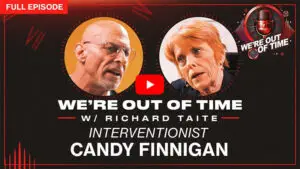
A family addiction intervention is a structured, clinical process in which loved ones — guided by a trained specialist — communicate the impact of a person’s substance use and present a concrete path to treatment. In this episode of We’re Out of Time, host Richard Taite sits down with Candy Finnigan, one of the most experienced intervention specialists in the United States, to examine what families get wrong about addiction, why love and ultimatums both fail without structure, and what actually moves someone toward treatment.

Finnigan is best known to millions as one of the intervention specialists on A&E’s long-running series Intervention, where she guided families through some of the most severe addiction cases documented on television. With more than 32 years and hundreds of cases behind her, she brings a dual perspective rare in the field: she is a working interventionist and a person in long-term recovery from alcoholism herself. Her book When Enough Is Enough: A Practical Guide to Helping Someone You Love through Addiction remains one of the most widely used practical resources for families navigating this process.

The conversation covers the most common mistakes families make — from unintentional enabling to emotionally escalating confrontations that push addicted loved ones further away — and the evidence-based principles that underpin effective intervention. For families in crisis, and for clinicians working with them, this episode offers both a framework and a hard-earned truth: getting someone into treatment is a clinical skill, not a function of how much you love them.

Key Insights

Why Most Families Approach Intervention Wrong — and What That Costs

▶ 06:00

Candy Finnigan opens with the observation that frames everything that follows: most families, by the time they reach out for help, have already attempted versions of an intervention on their own — and the experience has made things worse. The pattern is consistent: a family member reaches a breaking point, raises their voice, delivers an ultimatum, and the addicted person either escalates, withdraws, or briefly complies before returning to use. What families call a failed intervention is almost always a failed confrontation — an emotionally driven encounter that activates the defensive neurological responses addiction has sharpened into a reflex. Finnigan argues that confrontation is the opposite of what the clinical literature supports. The addicted brain does not respond to pressure by generating insight; it responds by generating resistance. What looks like stubbornness or denial is a neurologically coherent response to perceived threat. The intervention model she practices inverts the confrontational approach entirely: it is structured, calm, prepared, and led by someone with no emotional stake in the outcome — a design feature, not an accident.

The Enabling Dynamic: How Love Becomes a Barrier to Recovery

▶ 14:00

Finnigan is precise about enabling: it is not weakness. It is love in the wrong form. When a parent pays a DUI fine, calls in sick for a son who is hungover, or refuses to acknowledge a daughter’s relapse to protect family harmony, they are managing unbearable distress in the only way available to them. The clinical issue is that these behaviors remove the natural feedback loop that substance use depends on to become unsustainable. Every consequence absorbed by the family is a consequence that cannot accumulate in the addicted person’s experience. Finnigan describes this as resetting the clock: each consequence absorbed restarts the countdown to the threshold where the person’s own pain becomes motivation enough to seek change. The work of intervention begins here — restructuring family behavior around natural consequences is itself a clinical intervention, one that starts before any formal meeting.

Her Own Alcoholism: What Finally Moved Her Toward Treatment

▶ 22:00

Finnigan speaks directly about her own history with alcoholism — a disclosure she makes not as confession but as clinical evidence. She describes years of drinking she could not stop despite wanting to, despite knowing the damage it was causing, and despite the love of people around her. What finally moved her was not confrontation, not an ultimatum, not consequences alone — it was a specific encounter: non-judgmental, direct, and offering a clear exit. She names this the moment when intervention became her life’s work. The account is clinically instructive independent of its personal content: it illustrates why the message matters as much as the moment, why the relationship between the interventionist and the person being intervened upon is the active ingredient, and why someone who has been through addiction brings an irreplaceable quality of presence to guiding others through it.

What the A&E Show Got Right — and What It Couldn't Show

▶ 31:00

Finnigan discusses her years on Intervention honestly: the show captured something real about the desperation of families and the severity of addiction, and it brought formal intervention into mainstream awareness in a way that academic literature never could. But television compresses what clinical work cannot. What viewers did not see was the weeks of preparation before a single filmed session — the conversations with family members about enabling behaviors, the coaching on language and emotional regulation, the clinical assessment of whether the intervention was appropriately timed. What appeared on screen as a single emotionally charged meeting was the visible surface of a structured clinical process built over days. Finnigan notes that families who attempt to replicate the television model without clinical support — the surprise gathering, the circle of chairs, the letters — frequently produce the confrontational dynamic she spends her actual practice preventing. The takeaway is not that formal intervention doesn’t work. It is that what makes it work is invisible on camera.

What to Do When Someone Refuses Help — and What Never to Do

▶ 39:00

Finnigan closes with the question families ask most: what do you do when the person refuses? Her answer is structured around two principles. First, refusal is not final — it is a data point. Most people in active addiction have refused help before eventually accepting it, often multiple times. The clinical task is to keep the pathway to treatment open, not to force an immediate decision. Second, what families do after a refusal matters as much as what they did before: returning to enabling behaviors, expressing despair, or withdrawing entirely all communicate that the family’s stated boundaries were not real. Consistency is the clinical mechanism. When the family’s behavior reliably reflects what they said they would do — when consequences follow, when offers remain open, when enabling is genuinely stopped — the addicted person’s cost-benefit calculation shifts over time. This is not punishment. It is the removal of a subsidy that was sustaining a condition the whole family wants resolved.

Clinical Context

Family members are the most consistent and motivated external resource in the addiction treatment ecosystem — and the most consistently undertrained. Research published in the Journal of Substance Abuse Treatment finds that family-assisted treatment entry, when properly structured, increases the likelihood of treatment engagement by 64 percent compared to individual outreach. Yet most families approach a loved one’s addiction without clinical guidance, relying instead on emotional appeals, ultimatums, or silence — approaches that research consistently identifies as ineffective and, in many cases, counterproductive.

The enabling dynamic is among the most misunderstood concepts in addiction treatment. Clinical literature defines enabling as any behavior that reduces the natural negative consequences of substance use — covering financial losses, making excuses, absorbing legal or occupational fallout — with the effect of insulating the person from the feedback that might otherwise motivate change. Enabling is almost always an expression of love. Families enable because they cannot bear to watch suffering, because they fear the consequences of withdrawal, or because the enabling behavior briefly stops an acutely distressing situation. The neurological and relational logic is sound; the clinical outcome is the reverse of what families intend. By removing consequences, families inadvertently extend the time before a person reaches the threshold of self-motivated change.

Formal intervention, when conducted by a trained specialist, operates on a different clinical model. Rather than confrontation — the popular cultural image of the intervention — evidence-based intervention approaches, including CRAFT (Community Reinforcement and Family Training) and the Invitational Model, focus on restructuring the family system’s relationship with the addicted person: reducing enabling behaviors, increasing natural consequences, and creating a positive invitation toward treatment. The CRAFT model, developed by Dr. Robert Meyers at the University of New Mexico, has demonstrated in randomized controlled trials that it successfully engages treatment-resistant individuals in approximately 64 to 74 percent of cases — significantly outperforming both Al-Anon participation and traditional Johnson-style confrontational interventions.

About the Guest

Candy Finnigan

Candy Finnigan

MAC III, BRI II, C.C.D.C. - Certified Intervention Professional

Independent Practice

Candy Finnigan is one of the most recognized intervention specialists in the United States, with more than 32 years of experience guiding families through the process of helping addicted loved ones enter treatment. She is best known as one of the featured interventionists on A&E's Emmy Award-winning documentary series Intervention, which aired for 25 seasons and documented hundreds of real-world addiction cases. Over the course of her career, Finnigan has conducted hundreds of interventions across a full spectrum of substance use disorders and behavioral addictions, working with individuals and families from all socioeconomic backgrounds. She is the author of When Enough Is Enough: A Practical Guide to Helping Someone You Love through Addiction, published by Avery/Penguin, which remains a widely used resource for families seeking practical guidance on approaching a loved one about treatment. Finnigan brings a distinctly personal perspective to her work: she is herself a person in long-term recovery from alcoholism, a history she speaks about openly as a foundation for her clinical philosophy. Her approach emphasizes compassionate directness — the belief that families can love someone deeply while simultaneously refusing to absorb the consequences of their addiction — and that the structure and language of a properly conducted intervention are clinical tools, not emotional performances.

Frequently Asked Questions

CONFIDENTIAL CONSULTATION

Take the First Step

Carrara Treatment, Wellness & Spa offers personalized care. Consult a clinician to explore your options.

(888) 383-5207Contact Us

Episode Details

  • Episode: 63
  • Duration: 47 min
  • Published: December 16, 2025

FEATURED GUEST

Featured Guest

Candy Finnigan

Candy Finnigan

MAC III, BRI II, C.C.D.C.

CARRARA TREATMENT

More Episodes

CARRARA TREATMENT, WELLNESS & SPA

Confidential Consultation Available

Carrara Treatment, Wellness & Spa offers personalized care. Consult a clinician to explore your options.